
English spelling can sometimes be confusing, even when a word is used regularly in everyday conversations. Some words sound different from how people expect them to be written, while others contain letter combinations that are easy to mix up. One common example is the word surprise. Whether you are writing a birthday message, preparing a school assignment, sending a professional email, or sharing exciting news with a friend, spelling this word correctly helps make your message clear and polished. This is why many people search for how do you spell surprise when they want to confirm the correct spelling before writing.
The good news is that surprise is not difficult to learn once you understand its letter order and pronunciation. The correct spelling is S-U-R-P-R-I-S-E. Although the word may sound slightly different depending on a speaker’s accent, its standard written form remains the same. Learning this spelling can also help you recognize related words, understand how the word functions in a sentence, and avoid mistakes when communicating online or offline. With a few examples and simple memory techniques, you can become more confident about using surprise in different situations.
What Is the Correct Spelling of Surprise?
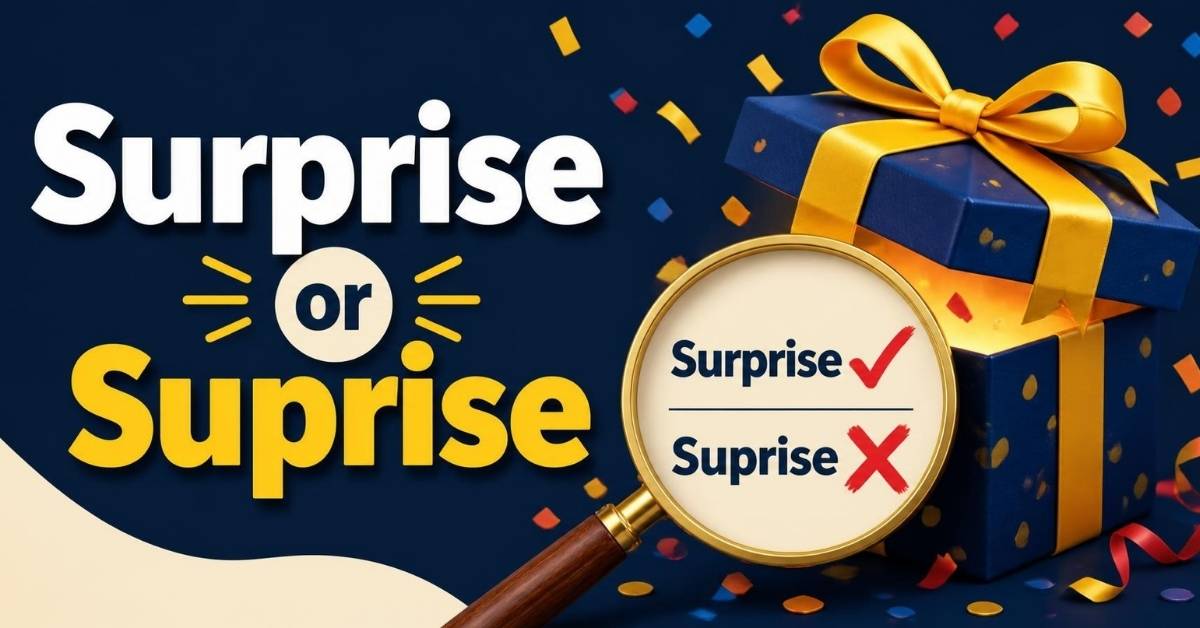
The correct spelling is surprise. It contains eight letters arranged in the following order: S, U, R, P, R, I, S, and E. A common source of confusion is the combination of the letters P and R in the middle of the word. Some people accidentally reverse these letters, add an unnecessary letter, or leave out one of the repeated letters. However, remembering the complete sequence makes the word much easier to write correctly.
When someone asks how do you spell surprise, the simplest answer is to break the word into smaller parts: sur-prize is a helpful way to think about its sound, but the correct spelling ends with -prise, not -prize. The final letter is E, and the word contains an S before that ending. Although surprise and prize may sound similar in some contexts, they are different words with different meanings and spellings. Practising the correct sequence a few times can help you recognize the word automatically whenever you need it.
A Simple Letter-by-Letter Breakdown
Breaking a long word into individual letters is a practical way to improve spelling. Instead of trying to remember the entire word at once, focus on its beginning, middle, and ending. Surprise starts with SUR, continues with PRI, and finishes with SE. Reading these parts slowly helps you remember the correct arrangement without becoming overwhelmed by the complete word.
You can also write the word several times while saying each letter aloud. For example, write surprise once, cover it, and then try to reproduce it from memory. Check your answer against the correct spelling and repeat the process if necessary. This small exercise is particularly useful for students, young learners, and anyone who frequently types messages on a phone or computer. After repeated practice, the correct spelling becomes easier to recall without checking a dictionary.
What Does the Word Surprise Mean?
The word surprise generally describes a feeling or event that happens unexpectedly. It can refer to something that causes astonishment, excitement, happiness, confusion, or even disappointment. A surprise occurs when an event differs from what someone anticipated. For example, receiving an unexpected gift from a friend may create a pleasant surprise, while discovering an unannounced change in a plan might produce a less welcome one.
Surprise can function as both a noun and a verb. As a noun, it describes an unexpected event or the feeling caused by that event. For example, in the sentence, “The party was a wonderful surprise,” the word identifies the unexpected celebration. As a verb, it describes the action of causing someone to feel surprised. In the sentence, “We decided to surprise our teacher with a thank-you card,” it explains what the group planned to do. Understanding these different uses makes it easier to apply the word naturally in everyday writing.
Examples of Surprise in Everyday Life
People experience surprises in many different situations. A child might receive an unexpected birthday present, a colleague might be recognized for excellent work, or a family might organize a special dinner to celebrate an important occasion. In each example, the unexpected nature of the event creates the element of surprise. The word is commonly associated with happiness, but its meaning is not limited to positive experiences.
For example, consider the sentence, “I was surprised when the train arrived earlier than expected.” Here, the speaker describes an unexpected event without necessarily expressing happiness or disappointment. Another example is, “The final result came as a surprise to everyone.” This sentence communicates that the outcome was different from what people had anticipated. These examples demonstrate why surprise is a useful word for describing reactions, experiences, and unexpected developments.
Common Spelling Mistakes to Avoid
Even familiar words can be misspelled when people write quickly or rely entirely on pronunciation. Surprise is sometimes written incorrectly because its middle consonants are easy to rearrange. Other mistakes happen when writers confuse the word with similar-looking terms or assume that the final sound should be represented by a Z. Recognizing these errors is the first step toward preventing them.
When learning how do you spell surprise, remember that the correct version contains eight letters and ends with SE. Avoid adding extra letters, changing the order of the middle consonants, or replacing the final S with a Z. The following table highlights common errors and the correct form.
| Incorrect spelling | Correct spelling | Explanation |
|---|---|---|
| Suprise | Surprise | The first R after U must be included. |
| Surprize | Surprise | The standard spelling ends in SE. |
| Surpriese | Surprise | The ending does not contain an extra E. |
| Surprizee | Surprise | The word has one final E, not an additional ending. |
| Suprrise | Surprise | The letters must appear in their correct sequence. |
A helpful habit is to pause for a moment before submitting an important message or document. Look at the word carefully and compare it with the spelling you have learned. Spell-checking tools can also identify many typing mistakes, but they should support your understanding rather than replace it completely. Some spelling errors may go unnoticed if a mistyped version resembles another valid word, so learning the correct form remains valuable.
Easy Ways to Remember the Spelling of Surprise
Memorization becomes easier when you use a method that suits your learning style. Some people remember words by writing them repeatedly, while others learn more effectively by speaking the letters aloud or using the word in sentences. For surprise, dividing the word into smaller sections is particularly useful because it directs attention to the middle consonants and the final letter combination.
Another effective approach is to connect the word with a familiar experience. Imagine someone unexpectedly bringing you a birthday cake. Write a sentence such as, “The cake was a surprise.” Connecting the spelling with a meaningful situation makes it easier to remember than simply looking at a list of letters. You can also practise writing short messages that use the word naturally, gradually building confidence through repetition.
A Quick Spelling Practice Method
Try the following simple exercise whenever you want to reinforce your memory:
-
Read the word surprise slowly and notice each letter.
-
Write it three times without looking at the original.
-
Use it in a sentence describing an unexpected event.
-
Check your spelling and correct any mistakes.
This activity takes only a minute or two and can be repeated whenever necessary. Consistent practice is usually more effective than attempting to memorize a word once and never reviewing it again. If you are helping a child learn English, you can turn the exercise into a small game by asking them to spell the word aloud before revealing the answer.
How to Pronounce Surprise Correctly
Pronunciation and spelling are closely related, but they do not always match perfectly in English. Surprise is commonly pronounced with the emphasis on the second syllable: suh-PRYZE. The first syllable is relatively light, while the second carries the stronger stress. Depending on the speaker’s accent, the exact vowel sounds may vary slightly, but the standard spelling remains unchanged.
The pronunciation can sometimes contribute to spelling confusion because the final sound resembles the word prize. However, the similarity in sound does not mean that the two words share the same ending. Surprise is spelled with S-E at the end, whereas prize ends with Z-E. Listening carefully to a word can help with pronunciation, but remembering established spelling patterns is essential when writing it correctly.
Why Pronunciation Alone Is Not Enough
English contains many words whose spelling cannot be predicted perfectly from their pronunciation. Different combinations of letters may produce similar sounds, and regional accents can influence how people pronounce particular words. As a result, relying entirely on what you hear may lead to errors when writing unfamiliar or confusing terms.
For this reason, it is useful to combine listening, reading, and writing. When you encounter surprise in a book, message, or article, pay attention to its written form as well as its meaning. Seeing the word repeatedly helps your brain recognize its structure, while writing it from memory strengthens recall. Over time, these habits can improve your overall spelling skills, not just your ability to write one particular word.
Using Surprise Correctly in Sentences
Understanding a word’s spelling is important, but knowing how to use it in a sentence makes your communication more effective. Surprise can describe an unexpected object, an unplanned event, an emotional reaction, or an action intended to catch someone off guard. The meaning becomes clear from the surrounding words, so learning through complete sentences is an excellent way to improve vocabulary and grammar simultaneously.
For example, you could write, “My parents planned a surprise dinner for my graduation.” In this sentence, surprise describes the dinner as something unexpected. Another example is, “The unexpected announcement surprised the entire class.” Here, surprised is the past-tense form of the verb surprise. A third example is, “Her reaction was a complete surprise to me.” In this case, the word functions as a noun. These examples show that the spelling remains consistent even when the word is used in different grammatical forms.
Related Words and Their Forms
Learning related forms can help you recognize the word more easily. The noun is surprise, the verb is surprise, and the adjective used to describe a person experiencing the feeling is surprised. The adjective surprising describes something that causes surprise. For example, you might say, “The result was surprising,” or, “Everyone was surprised by the result.”
Another common expression is “surprise party,” which refers to a celebration organized without informing the person being celebrated. The phrase “pleasant surprise” describes something unexpectedly enjoyable, while “to one’s surprise” introduces an event that was not anticipated. Becoming familiar with these expressions helps you use the word naturally in conversations, schoolwork, creative writing, and professional communication.
Why Correct Spelling Matters in Digital Communication
Digital communication has made writing an everyday activity for people of all ages. Messages, social media posts, emails, online forms, and workplace documents all require written language. Although small spelling errors rarely prevent people from understanding a message, frequent mistakes can affect readability and make writing appear less polished. Using familiar words correctly helps readers focus on the meaning rather than the errors.

For example, someone writing a birthday message might say, “I have a special surprise for you!” The sentence is short, clear, and easy to understand. In a professional setting, a manager might write, “The team has prepared a surprise announcement for the meeting.” In both situations, correct spelling supports effective communication. Taking a few seconds to check words before sending a message is a simple way to build stronger writing habits.
Spelling accuracy is also useful for students completing assignments and for professionals preparing reports or presentations. Search engines, digital assistants, and writing tools can help people check unfamiliar words, but understanding the correct spelling independently saves time and reduces uncertainty. Learning common vocabulary through regular reading and practice can gradually make everyday writing more accurate and natural.
Frequently Confused Words: Surprise and Prize
Surprise and prize look similar because they share several letters, but they have different meanings and spelling patterns. A prize is something awarded to someone for achievement, success, or winning a competition. A surprise is an unexpected event, experience, or feeling. The words may appear in the same situation, but they cannot always replace each other.
Consider the sentence, “She won a prize in the competition.” Here, prize refers to the reward she received. Now consider, “She was surprised when her name was announced.” In this example, surprised describes her reaction to an unexpected event. You could also say, “Winning the prize was a surprise.” This sentence uses both words correctly because the award itself was unexpected. Comparing words in context makes their meanings easier to understand and helps prevent spelling confusion.
Conclusion
Learning to spell common English words correctly is a practical skill that improves confidence in writing, communication, and everyday interactions. Surprise is a useful word because it describes unexpected events, emotional reactions, celebrations, and experiences that differ from what people anticipate. Once you understand its spelling, meaning, pronunciation, and grammatical forms, using it in different situations becomes much easier.
If you are still wondering how do you spell surprise, remember the correct eight-letter sequence: S-U-R-P-R-I-S-E. Pay particular attention to the middle letters and the ending, which can be confusing when you rely only on pronunciation. Practise writing the word, read it in complete sentences, and use it when describing familiar experiences. These small habits can help you remember the correct spelling for the long term.
Ultimately, the best way to improve spelling is through consistent practice rather than memorization alone. Read regularly, check unfamiliar words when necessary, and take a moment to review important messages before sending them. With these simple techniques, you can use surprise confidently in personal conversations, academic assignments, and professional writing while continuing to strengthen your English language skills.