
English spelling can sometimes be confusing, even for people who use the language every day. Certain words sound almost identical when spoken but have different letter arrangements when written. This often leads to spelling mistakes in emails, messages, school assignments, professional documents, and everyday conversations. One common example is the confusion between recieved and received. Although both spellings may look reasonable at first glance, only one is accepted as the correct standard spelling in modern English.
Understanding the difference is important because spelling accuracy influences how clearly and professionally people communicate. Whether someone is writing a business email, completing an examination, preparing a report, or posting on social media, using the correct form helps make the message more reliable. The confusion usually happens because English has several spelling patterns that do not always follow pronunciation.
The correct spelling is received, while recieved is a common spelling mistake. The word received is the past tense and past participle of the verb receive. It describes something that has been accepted, delivered, obtained, or taken into possession. In this article, we will explore its meaning, spelling rules, pronunciation, grammar, examples, and practical ways to remember the correct form.
Recieved or Received: Which One Is Correct?
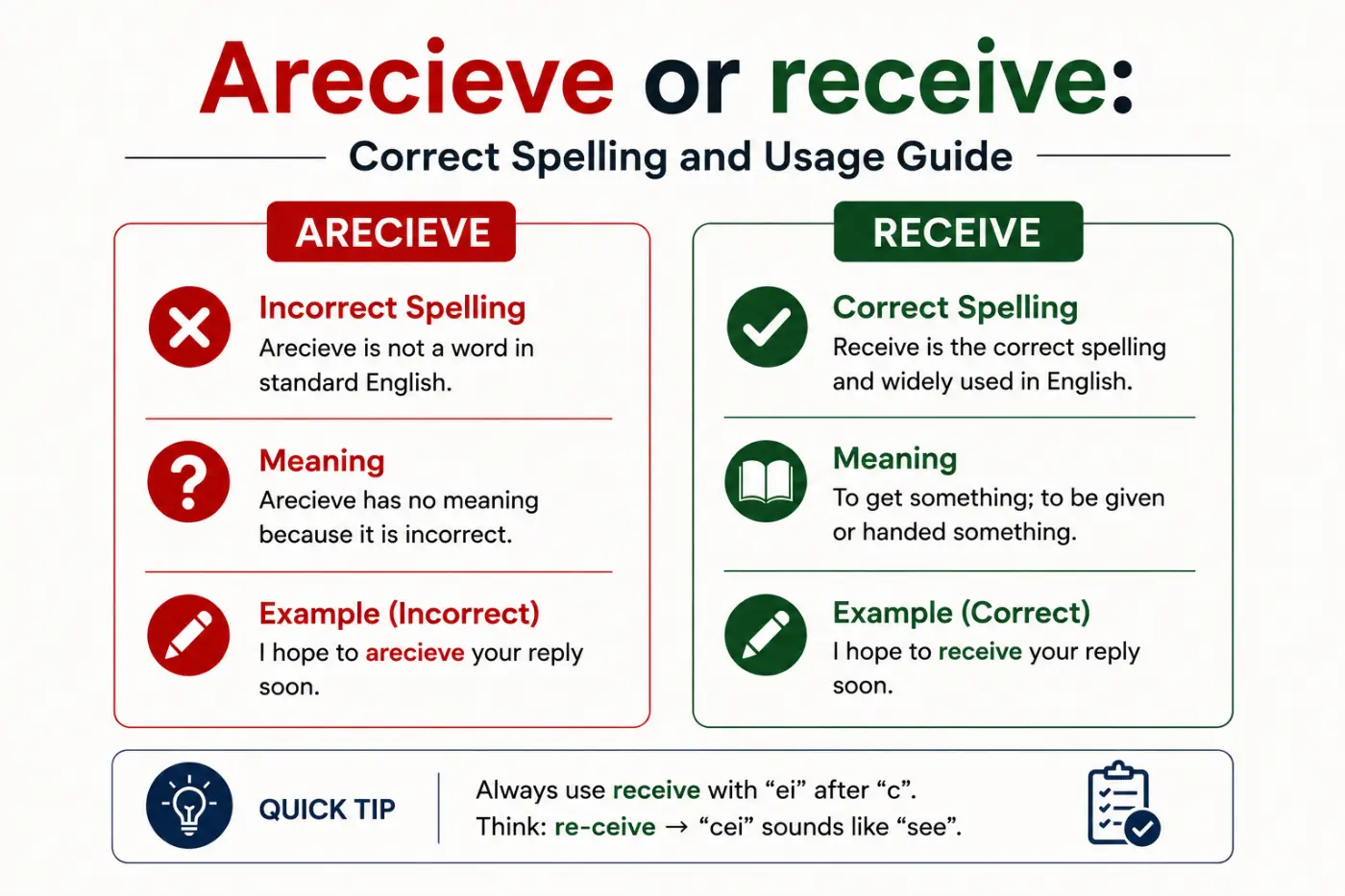
When comparing recieved or received, the correct choice is received. The spelling recieved is incorrect in standard English and should generally be avoided in formal and informal writing. Although people frequently type the incorrect version, it is not recognized as the standard spelling in reputable English dictionaries.
The confusion mainly comes from the placement of the letters E and I. Many English learners remember the familiar spelling principle that I usually comes before E. However, this general rule has exceptions, and receive is one of the words that follows a different pattern. In this word, the letters appear as C-E-I rather than C-I-E.
For example, consider the sentence, “I received your message yesterday.” Here, received correctly communicates that the speaker got the message. Writing “I recieved your message yesterday” would introduce a spelling error, even though the intended meaning would probably remain understandable.
Therefore, whenever you need to describe something that has arrived or been accepted in the past, received is the spelling you should use.
Understanding the Meaning of Received
Received is the past tense and past participle form of the verb receive. The basic meaning of receive is to get, accept, obtain, or be given something from another person, organization, or source. The word can describe physical objects, information, communication, invitations, payments, services, and many other things.
In everyday communication, received is commonly used when someone gets a message, parcel, email, document, or notification. For instance, a person might say, “I received a confirmation email from the company.” This means the email successfully reached them. Similarly, “She received a gift on her birthday” indicates that someone gave her a present.
The word also appears in professional and academic situations. Employees receive instructions, students receive certificates, businesses receive payments, and applicants receive decisions regarding their applications. Its meaning depends on the context, but the central idea remains the same: something has been obtained or delivered to someone.
Different Contexts in Which Received Is Used
The word received is flexible and works in several communication settings. In personal conversations, it can describe receiving a phone call, invitation, or present. In business communication, it can refer to payments, orders, official documents, or customer requests. In educational settings, it may describe marks, feedback, awards, or information.
It can also have meanings beyond physically obtaining something. For example, a new idea may be well received by an audience. In this expression, received describes how people respond to or accept something. A film can receive positive reviews, a proposal can receive approval, and a public announcement can receive attention.
These examples demonstrate why learning the correct spelling is useful. The word appears frequently across different subjects, professions, and everyday situations.
Why Do People Confuse Recieved and Received?
There are several reasons why people make this particular spelling mistake. The most important reason is the common English spelling rule involving I and E. Many learners are taught the phrase “I before E except after C.” While this phrase can help with certain words, it is not a universal rule. Unfortunately, people sometimes apply it incorrectly when spelling receive.
Another reason is pronunciation. In normal conversation, received is pronounced approximately as “ri-seevd.” The pronunciation does not clearly indicate whether the middle letters should be written as IE or EI. As a result, people may rely on their memory rather than a spelling pattern when typing the word.
Typing quickly can also contribute to the mistake. People often write emails, messages, and documents without carefully checking every word. Since the incorrect spelling looks similar to the correct one, it may go unnoticed during casual proofreading.
The Role of the I Before E Rule
The traditional spelling guideline suggests that I generally comes before E, except when the letters follow C. Words such as believe, achieve, and field demonstrate the common IE arrangement. Words such as receive, ceiling, and deceive demonstrate the EI arrangement after C.
However, English contains numerous exceptions, which means the rule should be treated as a helpful guideline rather than an absolute requirement. Memorizing frequently used words and practicing them in sentences is often more effective than relying entirely on a single spelling rule.
The Difference Between Recieved and Received
The main difference between these two forms is spelling accuracy. Both may be used by people intending to express the same meaning, but only received is correct in standard English.
| Feature | Recieved | Received |
|---|---|---|
| Spelling status | Incorrect | Correct |
| Dictionary usage | Nonstandard misspelling | Standard English word |
| Meaning | Intended meaning of receive | Obtained or accepted |
| Grammar | Incorrect written form | Past tense and past participle |
| Professional usage | Avoid | Recommended |
The incorrect version contains the letters I and E in the wrong order. The correct version follows the spelling pattern found in receive, where E comes before I after the letter C.
This difference may appear small, but it matters in written communication. Correct spelling makes sentences easier to understand and helps readers focus on the message instead of noticing avoidable mistakes.
How to Use Received Correctly in Sentences
Learning spelling becomes easier when you understand how a word works in real sentences. Received is commonly used to describe completed actions involving communication, delivery, acceptance, and recognition.
For example, when someone says, “We received the package this morning,” the sentence explains that the package arrived earlier that day. In another situation, “The student received an award for excellent performance” describes an achievement or recognition.
The word can also be used in formal writing. A business might write, “Your application has been received and is currently under review.” This sentence confirms that the application reached the organization. Similarly, a customer service representative might say, “We received your complaint and will respond shortly.”
Common Sentence Examples
Here are some practical examples that demonstrate the correct usage:
-
I received your email yesterday evening.
-
She received a certificate for her achievements.
-
The company received several new orders.
-
We received confirmation of the booking.
-
He received an invitation to the event.
These sentences show how received can be used in personal, professional, educational, and business communication. Reading examples regularly can help make the correct spelling more familiar.
Received in Different Forms of English Grammar
To understand received completely, it is helpful to examine its relationship with other forms of the verb receive. Like many English verbs, receive changes its form depending on the tense and grammatical structure of a sentence.
The base form is receive. The present simple form can be receive or receives, depending on the subject. The continuous form is receiving, while the past tense and past participle forms are both received.
For example, “I receive emails every day” describes a regular activity. “She is receiving a parcel” describes something happening at the moment. “They received the documents yesterday” describes a completed action in the past.
Understanding these forms helps prevent confusion when constructing sentences. It also makes it easier to identify where received should appear in different grammatical situations.
Receive, Receives, Receiving, and Received
The following examples explain how the verb changes:
| Verb form | Example sentence |
|---|---|
| Receive | I receive regular updates. |
| Receives | He receives weekly reports. |
| Receiving | She is receiving a delivery. |
| Received | They received the information. |
The past participle received can also be used with helping verbs. For example, “I have received your application” uses the present perfect tense. Similarly, “The payment was received yesterday” uses a passive construction.
These grammatical patterns are especially useful when writing professional emails, reports, and official communication.
Practical Tips to Remember the Correct Spelling
Remembering the correct spelling does not require complicated grammar lessons. A few simple techniques can make it easier to avoid the common mistake. The first approach is to memorize the base word receive. Since received comes directly from receive, remembering the original word makes the past-tense spelling easier.
Another useful technique is to break the word into smaller parts. Think of it as re-ceive-d when practicing its spelling. Repeating the correct letter arrangement several times can help develop familiarity. Writing the word in different sentences is also an effective way to improve spelling confidence.
You can also use spelling and grammar checkers when preparing important documents. Most modern word processors and mobile keyboards identify common spelling mistakes automatically. However, these tools should support your learning rather than replace it completely.
A particularly helpful practice is to remember the following points:
-
Remember that receive is the base verb.
-
Use received for the past tense and past participle.
-
Place E before I after the letter C.
-
Read your writing carefully before submitting it.
Regular reading can also improve spelling naturally. Newspapers, books, educational articles, and professional documents expose readers to correct word usage. Over time, familiar words become easier to recognize without consciously thinking about every letter.
Common Mistakes to Avoid When Writing Received
One frequent mistake is using the incorrect spelling in professional emails. For example, writing “I have recieved your payment” may make an otherwise clear message appear less polished. The correct sentence is “I have received your payment.” Small errors can affect the overall impression of business communication, particularly when writing to clients, managers, or customers.
Another mistake involves assuming that a word is correct simply because it appears frequently online. Search results, social media posts, informal messages, and user-generated content sometimes contain spelling errors. Seeing the same incorrect form repeatedly does not make it grammatically acceptable.
People may also confuse the past tense and present tense when constructing sentences. For example, “I received your message yesterday” is correct because the action happened in the past. However, “I receive your message yesterday” is grammatically incorrect because the verb tense does not match the time reference.
How to Correct Spelling Mistakes Effectively
The best way to improve spelling is to develop a habit of checking unfamiliar words. Instead of guessing between two similar forms, consult a reliable dictionary or use a trusted spelling tool. When you discover an error, write the correct form several times and use it in meaningful sentences.
It is also useful to create a personal list of frequently misspelled words. Words such as separate, definitely, accommodation, and receive are common examples. Reviewing this list occasionally can improve everyday writing and reduce repeated mistakes.
Why Correct Spelling Matters in Digital Communication
Digital communication has become an essential part of modern life. People use emails, messaging applications, online forms, educational platforms, and professional networks to exchange information. Because much of this communication happens through written language, correct spelling remains important.
Using the correct form of a word helps create a professional impression. For example, a job applicant sending an application email should carefully check spelling and grammar before submitting it. Similarly, businesses communicating with customers need clear and accurate messages to maintain trust.
Search engines and digital publishing platforms also depend on well-organized written content. While a single spelling mistake does not automatically determine the quality or ranking of an article, accurate language improves readability and creates a better experience for visitors. Content creators should therefore review their work before publishing.
The confusion surrounding received is a useful reminder that even familiar English words deserve attention. Developing good proofreading habits can prevent small errors from affecting the quality of larger documents.
Frequently Asked Questions About Received
Is recieved a real English word?
Recieved is a common spelling mistake, not the standard spelling of an English word. The correct form is received. It is best to avoid the incorrect version in emails, assignments, articles, and professional documents.
Is received the correct spelling?
Yes, received is the correct spelling. It is the past tense and past participle of receive. It is used when describing something that someone obtained, accepted, or was given.
Why is received spelled with EI?
The word receive follows the spelling pattern in which E comes before I after C. Although the traditional I-before-E guideline can be useful, it has several exceptions, including receive, ceiling, and deceive.
What is the difference between receive and received?
Receive is the base form of the verb, while received is its past tense and past participle. For example, “I receive messages daily” describes a regular activity, whereas “I received a message yesterday” describes a completed action.
Can I use received in professional emails?
Yes. Received is widely used in professional communication. Expressions such as “We have received your request” and “I received the documents” are grammatically correct and appropriate for workplace emails.
How can I remember the spelling of received?
Remember the base word receive and notice the EI combination after C. Practicing the word in sentences, reading regularly, and checking your writing can help you remember the correct spelling.
Conclusion
English spelling can be challenging because pronunciation, spelling patterns, and traditional grammar rules do not always work together consistently. The confusion between recieved and received is a good example of how a small difference in letter placement can create a common writing mistake. Although both forms may look similar, only received is accepted as the correct standard spelling.
Remember that received is the past tense and past participle of receive. It is used in everyday conversations, professional emails, academic writing, business communication, and many other situations. Learning its spelling pattern and practicing it in meaningful sentences can help you avoid mistakes.
The simplest way to remember the correct form is to memorize receive first and then add D to create received. By developing regular reading and proofreading habits, you can improve your English spelling and communicate with greater confidence. Always choose the correct spelling, received, whenever you want to express that something was obtained, accepted, or delivered in the past.