
English spelling can sometimes be confusing, especially when a word does not sound exactly as it is written. Some words contain silent letters, unusual combinations of vowels, or consonants that people frequently forget. One such word is surprise. Whether you are writing a birthday message, sending an email, preparing a school assignment, or communicating professionally, knowing the correct spelling of everyday words helps you express yourself clearly. This is why many people search for how do you spell surprise when they want to confirm the correct arrangement of its letters.
The correct spelling is surprise. It contains eight letters: S, U, R, P, R, I, S, and E. Although the word is commonly used in conversations and written communication, people sometimes misspell it as “suprise” by leaving out the second letter R. Understanding its spelling, pronunciation, meaning, and practical usage can help you remember it more easily. With a few simple explanations and examples, you can become more confident when using this word in everyday situations.
What Is the Correct Spelling of Surprise?
The correct spelling of the word is surprise. It is written as S-U-R-P-R-I-S-E and contains eight letters. The most important detail to remember is that the word has two R letters. One appears after the U, while the second comes immediately after the P. Forgetting the second R is one of the most common spelling mistakes associated with this word.
When someone asks how do you spell surprise, the simplest answer is to remember the complete sequence rather than relying only on pronunciation. The word begins with “sur,” followed by “prise.” Combining these two parts gives you surprise. This small spelling pattern makes it easier to recognize the correct form whenever you encounter the word in a sentence, message, or written document.
Breaking the Word Into Smaller Parts
Breaking longer words into smaller sections is an effective spelling technique. Instead of trying to memorize all eight letters at once, divide surprise into two parts: “sur” and “prise.” The first part contains S, U, and R, while the second contains P, R, I, S, and E. When these parts are combined, they create the complete word.
Another useful method is to write the word several times while saying each letter aloud. Repetition helps your brain recognize the correct arrangement. You can also compare the correct spelling with the commonly misspelled version, “suprise.” Seeing the missing R makes the difference easier to remember.
Understanding the Meaning of Surprise
Surprise is a word used to describe something unexpected or an experience that causes someone to feel sudden excitement, happiness, confusion, or amazement. It can refer to an event, an announcement, a gift, or an unexpected situation. The feeling associated with surprise depends on what happens and how a person reacts to it.
For example, imagine someone returning home after a long day and discovering that their family has organized a birthday celebration. The unexpected decorations, cake, and presence of loved ones create a pleasant surprise. However, the word is not limited to happy experiences. Receiving unexpected news, discovering an unusual result, or encountering an unfamiliar situation can also create surprise.
Surprise as a Noun
As a noun, surprise refers to an unexpected event, experience, or feeling. It can describe something that happens without warning or an emotional reaction to an unfamiliar situation. People commonly use the noun when talking about celebrations, gifts, announcements, and unexpected discoveries.
For example, someone might say, “The birthday party was a wonderful surprise.” In this sentence, surprise refers to the unexpected celebration. Another example is, “Her visit was a complete surprise.” Here, the word describes an unexpected arrival.
Surprise as a Verb
Surprise can also function as a verb. In this form, it describes the action of causing someone to experience an unexpected feeling or reaction. The word can be used when someone organizes an unexpected event, reveals surprising information, or does something another person did not anticipate.
For example, “I want to surprise my friend with a special gift.” In this sentence, surprise describes the action of creating an unexpected experience. Other forms include surprises, surprised, and surprising. These variations are useful in different grammatical situations, but they retain the same basic spelling structure.
Why Do People Commonly Misspell Surprise?
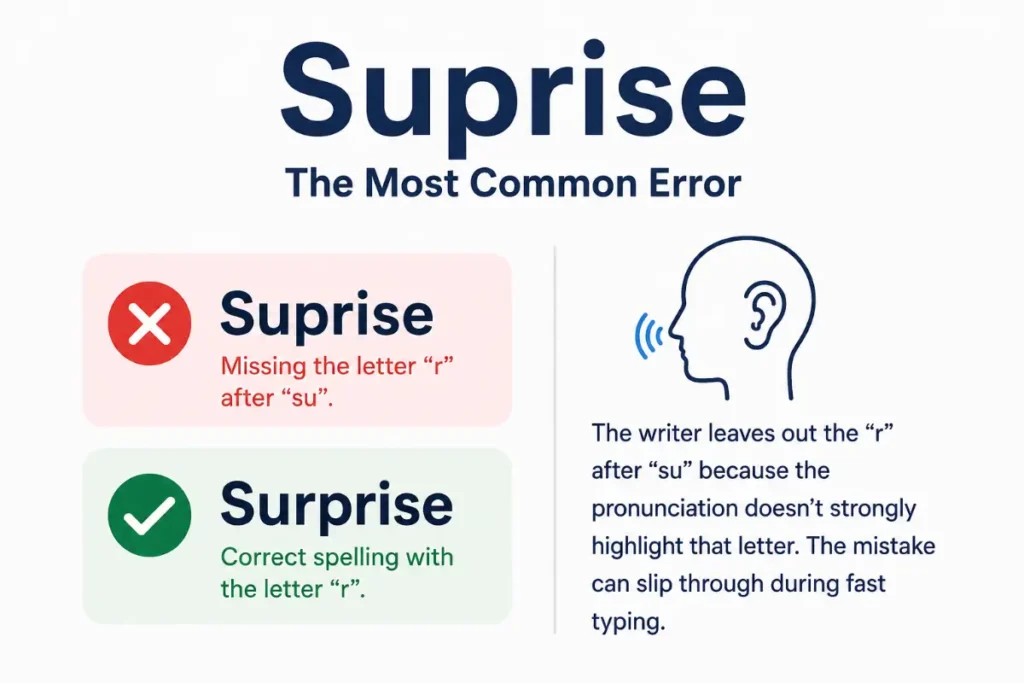
There are several reasons why people make mistakes when writing surprise. One major reason is pronunciation. In everyday speech, people often pronounce words quickly and do not clearly notice every individual sound. As a result, they may remember the sound of a word without remembering its exact letter arrangement.
Another reason is the repeated use of informal digital communication. Text messages, social media comments, and quick online conversations encourage people to type quickly. When someone writes without checking their spelling, small mistakes can easily become habits. The incorrect form “suprise” may appear familiar because it is frequently typed by people who accidentally leave out one R.
The Difference Between Surprise and Suprise
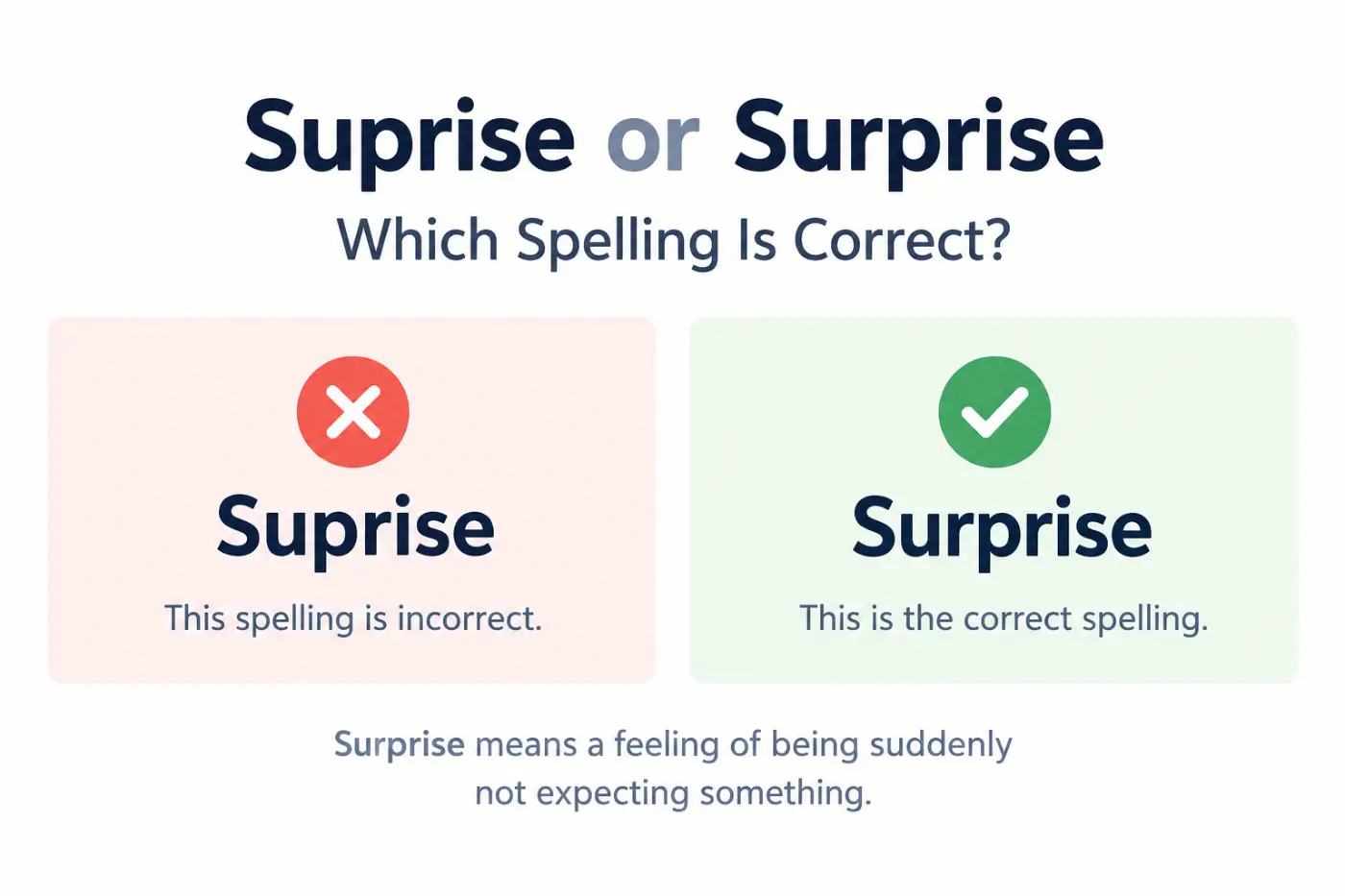
The difference between these two spellings is simple but important. Surprise is the correct English spelling, while suprise is incorrect. The incorrect version leaves out the second R, which changes the standard written form of the word.
| Spelling | Status | Explanation |
|---|---|---|
| Surprise | Correct | Standard English spelling |
| Suprise | Incorrect | Missing the second R |
| Surprize | Incorrect in standard modern English | Nonstandard alternative spelling |
Remembering this distinction is particularly helpful when writing schoolwork, professional emails, social media captions, and personal messages.
How to Remember the Correct Spelling of Surprise
Learning the correct spelling becomes easier when you use simple memory techniques. Instead of memorizing the word randomly, focus on its letter pattern. Remember that surprise contains two R letters, and the second R comes directly after P. This is the most useful detail to keep in mind whenever you write the word.
You can also practice by including surprise in short sentences. For example, write about a surprise birthday party, an unexpected phone call, or a special gift. When you repeatedly use a word in meaningful sentences, you become more familiar with its spelling and meaning.
Some practical techniques include:
- Divide the word into “sur” and “prise” to remember its structure.
- Write surprise five times without looking at the correct version.
- Read sentences containing the word to recognize its spelling.
- Check the spelling before submitting important written work.
These techniques are useful for students, English learners, professionals, and anyone who wants to improve their written communication.
Examples of Surprise in Everyday Sentences
Understanding spelling is important, but knowing how to use a word correctly is equally valuable. Surprise appears in many everyday conversations because people frequently discuss unexpected events, celebrations, gifts, and reactions. Learning through examples helps you understand how the word works in different contexts.
Consider the sentence, “My parents planned a surprise for my birthday.” Here, surprise is used as a noun because it refers to an unexpected event. In another example, “She wanted to surprise her brother with a new bicycle,” the word functions as a verb because it describes an action.
Here are additional examples that demonstrate its usage:
- The unexpected announcement came as a surprise to everyone.
- We organized a surprise party for our teacher.
- His sudden arrival surprised all his friends.
- I was surprised to receive such a thoughtful gift.
- The movie had a surprising ending.
Each sentence uses a different grammatical form or context. Practicing these examples can improve your vocabulary while reinforcing the correct spelling.
Different Forms of the Word Surprise
The word surprise can appear in several grammatical forms. Learning these variations helps you understand how the original word changes depending on the sentence structure. Although the endings may change, the main spelling pattern remains recognizable.
The noun form is surprise, while the plural form is surprises. The verb can appear as surprise, surprises, or surprised, depending on the subject and tense. The adjective form surprising describes something that causes an unexpected reaction. Meanwhile, surprised describes how someone feels after experiencing something unexpected.
For example, “The results were surprising” describes the results themselves. On the other hand, “I was surprised by the results” describes a person’s reaction. Understanding these differences allows you to use the word naturally in both spoken and written English.
Is Surprise Difficult to Spell for English Learners?
English learners sometimes find surprise challenging because its pronunciation does not always make the spelling pattern obvious. Unlike certain words that can be written exactly as they sound, surprise requires attention to individual letters. The repeated R and the ending “ise” can create confusion for people who are still developing their English vocabulary.
However, the word becomes easier with regular practice. Learners can improve their spelling by reading English books, writing short paragraphs, and checking unfamiliar words while studying. Keeping a personal vocabulary notebook is another helpful approach. Whenever you encounter a difficult word, write its correct spelling, meaning, and one example sentence.
If you are learning English as a second language, do not feel discouraged by occasional spelling mistakes. Spelling improves gradually through exposure and repetition. Recognizing frequently misspelled words is an important step toward becoming a more confident writer.
When Should You Use the Word Surprise?
Surprise is appropriate in both casual and formal communication, although the surrounding sentence determines whether it sounds natural. In personal conversations, it is commonly used when discussing unexpected gifts, celebrations, visits, or experiences. For example, “I have a surprise for you” is a natural way to build excitement before revealing something unexpected.
In professional communication, the word can describe unexpected developments, positive results, or unanticipated information. A business report might mention that a sudden increase in demand surprised the management team. Similarly, an employee could describe an unexpected announcement as a pleasant surprise. Using the word correctly makes communication more precise and understandable.
Common Spelling Mistakes to Avoid
People sometimes confuse surprise with other words that have similar sounds or spelling patterns. The most important mistake to avoid is leaving out the second R. Although “suprise” may look acceptable at first glance, it is not the correct spelling in standard English.
Another mistake is using “surprize” in ordinary modern English writing. Although this alternative spelling has historical usage, surprise is the standard form expected in contemporary English. Students and professionals should use the standard spelling to maintain consistency and avoid unnecessary errors.
Proofreading is especially important when writing longer documents. A quick review can help identify missing letters, incorrect endings, and other small mistakes. Spell-checking tools can also be useful, but understanding the correct spelling yourself is more reliable than depending entirely on automatic corrections.
Frequently Asked Questions
How do you spell surprise correctly?
The correct spelling is surprise. It contains eight letters: S, U, R, P, R, I, S, and E. Remember that it has two R letters.
Is it spelled surprise or suprise?
Surprise is correct, while suprise is incorrect. The second R is missing from the incorrect version.
How many letters are in surprise?
The word surprise contains eight letters. These are S, U, R, P, R, I, S, and E.
What is the meaning of surprise?
Surprise refers to an unexpected event, experience, or emotional reaction. It can describe something pleasant, unpleasant, exciting, or unusual.
What are the different forms of surprise?
Common forms include surprise, surprises, surprised, and surprising. Their grammatical usage depends on the sentence.
Is surprise a noun or a verb?
Surprise can function as both a noun and a verb. As a noun, it describes an unexpected event or feeling. As a verb, it describes the action of causing someone to feel unexpected amazement.
Conclusion
Spelling everyday English words correctly is an important part of effective communication. Although surprise may seem like a simple word, its repeated R can cause confusion for students, English learners, and people who type quickly. The easiest way to avoid this mistake is to remember its complete eight-letter structure: S-U-R-P-R-I-S-E.
Whenever someone asks how do you spell surprise, remember that the correct answer is surprise, not suprise. Practice writing it in different sentences, understand its meaning, and pay attention to its grammatical forms. With regular reading and writing, remembering the correct spelling will become natural. Whether you are preparing a birthday message, writing a professional email, or improving your English vocabulary, using the correct spelling will make your communication clearer and more confident.