
English spelling can sometimes be confusing, especially when a word contains letters that are not pronounced exactly as they appear. Some words sound simple when spoken but become difficult to spell when writing an email, completing an assignment, or sending a message. Surprise is one such word. Although it is commonly used in everyday conversations, many people accidentally misspell it by leaving out a letter or changing the order of certain letters. Learning its correct spelling can help improve writing accuracy and communication.
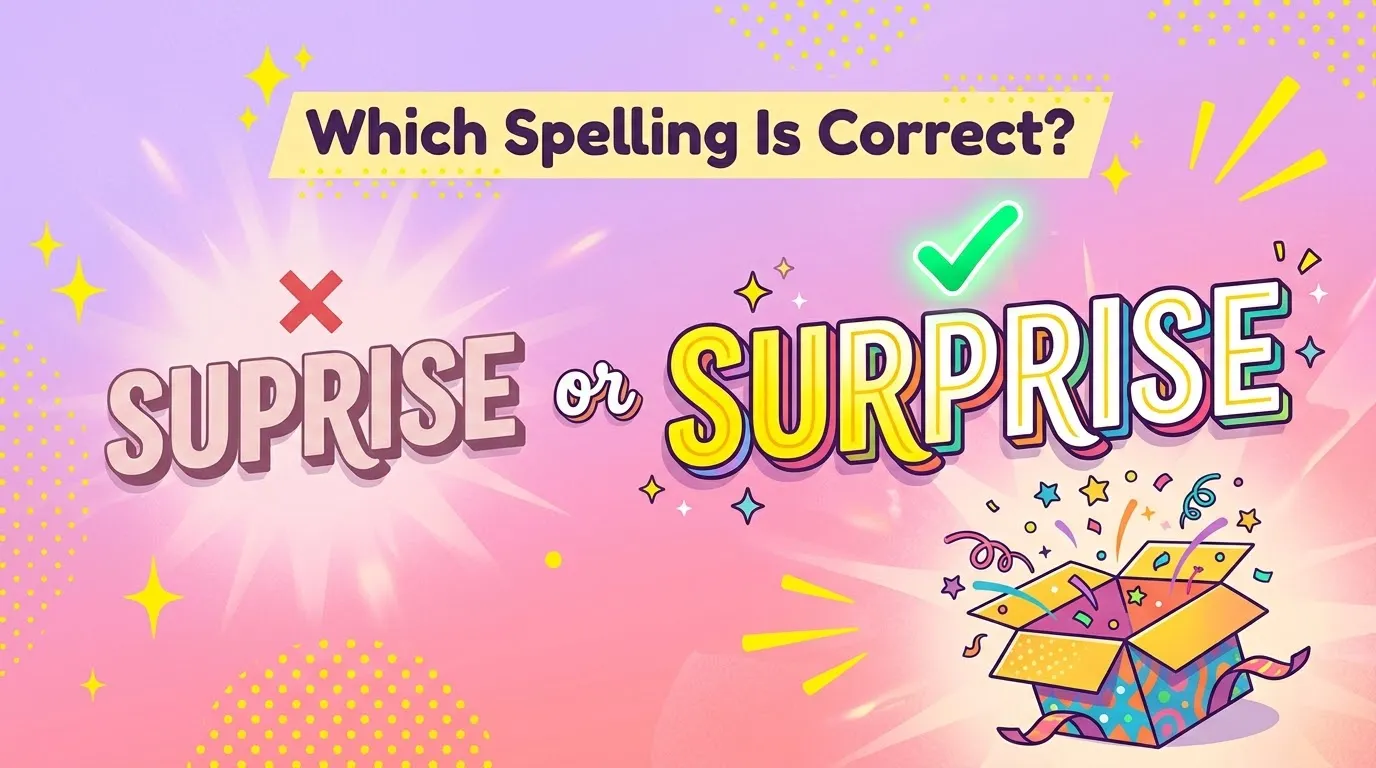
If you have ever wondered how do you spell surprise, the correct spelling is surprise. It contains eight letters: S-U-R-P-R-I-S-E. The word is used when something unexpected happens or when someone experiences a feeling of amazement because an event occurs without warning. From birthday celebrations and unexpected gifts to sudden announcements and exciting news, surprise is an important word in everyday English.
Understanding the correct spelling, pronunciation, meaning, and practical usage of this word can make it easier to remember. Instead of memorizing individual letters repeatedly, you can learn its structure and recognize common mistakes. This guide explains everything you need to know about the word, including examples, spelling techniques, grammatical uses, and helpful ways to avoid errors.
How Do You Spell Surprise Correctly?
The correct spelling is surprise.
The word contains eight letters arranged in the following order:
S – U – R – P – R – I – S – E
One common reason people misspell this word is that they confuse the position of the letters R and P. Others may accidentally write an extra letter or replace the final E with another vowel. However, remembering the complete letter sequence makes the spelling much easier.
For example, if you want to write a sentence about an unexpected birthday party, you could say, “My friends planned a wonderful surprise for my birthday.” In this sentence, surprise describes something that was not expected and created a positive emotional reaction.
When someone asks how do you spell surprise, it is helpful to remember that the word begins with SUR and ends with PRISE. Breaking it into smaller parts can make it easier to recognize and reproduce correctly.
What Does the Word Surprise Mean?
Surprise refers to something unexpected or an emotional reaction caused by an event that happens without being anticipated. It can describe a situation, an experience, a gift, an announcement, or a feeling. The word is generally associated with amazement, excitement, happiness, or confusion, depending on the circumstances.
For instance, receiving an unexpected gift from a friend can create a pleasant surprise. Similarly, discovering that you have passed an examination when you were expecting a different result may surprise you. However, the word is not always connected to positive experiences. An unexpected problem, sudden change, or shocking announcement can also create surprise.
In everyday communication, people use this word in different situations. It appears in conversations, social media captions, personal messages, news reports, entertainment, and professional writing. Its meaning remains connected to something that was not expected, even when the emotional reaction changes.
Different Meanings of Surprise
The word can have slightly different meanings depending on how it is used in a sentence.
As a noun, surprise describes an unexpected event or feeling. For example, “The announcement was a complete surprise.”
As a verb, surprise describes the action of causing someone to feel unexpected amazement. For example, “I wanted to surprise my sister with a special gift.”
It can also describe an unexpected situation. For example, “The team surprised everyone by winning the competition.”
Recognizing these different uses helps you understand the word more naturally and use it correctly in your writing.
Why Do People Commonly Misspell Surprise?
Even people who regularly communicate in English sometimes make spelling mistakes. The main reason is that English pronunciation does not always provide a clear indication of how every word should be written. Some letters are pronounced quickly, while others may sound less noticeable during normal conversation.
The word surprise can be particularly confusing because of its internal letter arrangement. People sometimes write “suprise” because they accidentally remove the second R. Others may type “surprize” because they confuse the standard spelling with the pronunciation of the final sound.
Typing quickly on smartphones and computers can also increase the possibility of spelling errors. When people send messages in a hurry, they may depend on memory rather than checking the spelling carefully. Although autocorrect can identify some mistakes, it does not always recognize the intended word correctly.
Another reason is the influence of informal online communication. Social media conversations often encourage abbreviations and relaxed spelling habits. Over time, repeatedly seeing incorrect spellings can make them appear familiar. This is why learning the standard spelling is important, particularly in academic and professional communication.
Common Misspellings of Surprise and Their Corrections
Several incorrect versions of this word appear in everyday writing. Understanding these mistakes can help you identify and correct them before publishing a message, document, or article.
| Incorrect spelling | Correct spelling | Explanation |
|---|---|---|
| Suprise | Surprise | The second R is missing. |
| Surprize | Surprise | The final S should not be replaced with Z. |
| Surpries | Surprise | The final letters are incorrectly arranged. |
| Suprrise | Surprise | An extra R has been added. |
| Surprisse | Surprise | An extra S has been included. |
Among these mistakes, “suprise” is particularly common because people often overlook the second R. The easiest way to avoid this error is to remember that surprise contains two R letters and two S letters.
Whenever you are unsure about the spelling, write the word slowly and check every letter. This small habit can prevent repeated mistakes and gradually improve your spelling confidence.
How to Remember the Correct Spelling of Surprise
Memorizing a word becomes easier when you connect its spelling with a simple technique. Rather than repeating the entire word without understanding its structure, try dividing it into smaller sections.
One useful method is to remember the word as SUR + PRISE. The first part contains three letters, while the second part contains five letters. When you combine them, you get the complete eight-letter word.
Another effective approach is to write the word several times while saying each letter aloud. This creates a connection between visual memory, pronunciation, and writing. Practicing the word in meaningful sentences can also help you remember its spelling naturally.
Here are a few simple techniques:
-
Remember that surprise contains eight letters.
-
Pay attention to the two R letters.
-
Practice writing the word in complete sentences.
-
Read the word regularly in books and articles.
-
Check spelling before submitting important writing.
Consistency is more useful than memorizing the spelling once. Practicing a word in different contexts helps your brain recognize its correct form automatically.
How Is Surprise Pronounced?
The pronunciation of surprise is another important part of learning the word. In standard English, it is commonly pronounced as suh-PRIZE. The emphasis generally falls on the second syllable, which makes the final portion of the word sound stronger.
Although pronunciation can vary slightly between accents, the standard written spelling remains the same. This distinction is important because some people assume that a word should be written exactly as it sounds. English does not always follow this pattern.
For example, the final sound in surprise resembles the sound of the word “prize.” However, the correct spelling uses an S rather than a Z. This difference explains why some writers mistakenly use “surprize.”
The best way to become familiar with pronunciation is to listen to spoken English and repeat the word naturally. Reading sentences aloud can also improve your understanding of how the word fits into everyday communication.
How to Use Surprise in Everyday Sentences
Learning the spelling of a word is only one part of developing strong vocabulary skills. You should also understand how to use it naturally in different situations.
Surprise can appear in personal conversations, professional communication, educational writing, and creative storytelling. Its flexibility makes it a useful word for expressing unexpected experiences and reactions.
Consider these examples:
-
My parents planned a surprise celebration for my graduation.
-
The unexpected result came as a surprise to everyone.
-
I wanted to surprise my best friend with a thoughtful present.
-
The final announcement surprised the entire audience.
-
Her visit was a wonderful surprise after several months.
These sentences demonstrate how the word can function as both a noun and a verb. Paying attention to the surrounding words will help you determine which grammatical form is appropriate.
Using Surprise in Questions and Conversations
People frequently use surprise when asking questions or expressing excitement. For example, someone might say, “What a wonderful surprise!” when receiving an unexpected present.
Another common expression is “Are you planning a surprise?” This question is often used when discussing birthdays, celebrations, or special occasions.
You may also hear the phrase “surprise me,” which means asking someone to choose or do something unexpected. For example, a customer visiting a restaurant might tell a waiter, “Surprise me with your best recommendation.”
These expressions demonstrate that surprise is not limited to formal writing. It is an everyday vocabulary word that makes conversations more expressive and natural.
What Is the Difference Between Surprise and Surprised?
Surprise and surprised are closely related words, but they do not have exactly the same grammatical function.
Surprise can be used as a noun or verb, whereas surprised is generally used as an adjective or the past-tense and past-participle form of the verb.
For example, “The party was a surprise” uses surprise as a noun. On the other hand, “I was surprised by the party” uses surprised to describe someone’s emotional reaction.
Understanding this difference is important because using the wrong form can change the meaning of a sentence.
Here are some additional examples:
Surprise: The unexpected phone call was a complete surprise.
Surprised: She looked surprised when she opened the box.
Surprising: The final result was surprising to the entire team.
Surprisingly: Surprisingly, the small team completed the project ahead of schedule.
All four words are connected, but they perform different roles in English sentences.
When Should You Use the Word Surprise?
Surprise is suitable whenever you want to describe an unexpected event, reaction, or experience. It can be used in both casual and formal communication, depending on the sentence.
In personal communication, it is commonly associated with gifts, celebrations, visits, and unexpected messages. For example, a person might write, “Thank you for the beautiful surprise. It made my day special.”
In professional environments, the word can describe unexpected developments, business results, customer reactions, or important announcements. A manager might say, “The latest sales figures were a positive surprise for the company.”
In storytelling, surprise is also useful for creating suspense and keeping readers interested. Writers often introduce unexpected developments to make a story more engaging. A sudden revelation or an unexpected character decision can completely change the direction of a narrative.
The key is to use the word in a context where something differs from what someone originally expected.
How Do You Spell Surprise in Academic and Professional Writing?
Correct spelling is particularly important in academic and professional environments because written communication often reflects attention to detail. A spelling mistake in an assignment, application, presentation, or business email may distract readers from the actual message.
Students should learn the correct spelling of commonly used vocabulary words to improve their written assignments and examination answers. When writing an essay about memorable experiences, for example, surprise may be useful when describing an unexpected event or important moment.
Professionals can also use the word in reports, presentations, and workplace discussions. Consider the sentence, “The customer response was a pleasant surprise for our marketing team.” It communicates an unexpected positive outcome in a clear and natural way.
Modern writing tools can help identify spelling mistakes, but relying entirely on automated suggestions is not a good long-term strategy. Understanding spelling patterns allows you to recognize errors independently and produce more confident writing.
Quick Practice to Improve Your Spelling
The best way to remember a new word is to use it actively. Instead of simply reading the correct spelling, test yourself by writing it from memory and comparing your answer with the standard version.
You can also create short exercises using different sentence structures. For example, complete the sentence, “My friends gave me a wonderful ______ on my birthday.” The correct answer is surprise.
Another useful exercise is to identify incorrect spellings in short paragraphs. This develops attention to detail and makes it easier to recognize mistakes when reading your own work.
Try following a simple practice routine:
-
Write surprise five times without looking at the correct spelling.
-
Use it in three different sentences.
-
Identify its noun and verb forms.
-
Review the word again after a few hours.
Practicing for just a few minutes can gradually improve spelling accuracy. The goal is not simply to memorize one word but to develop better spelling habits that can be applied to other English vocabulary.
Conclusion
Learning the correct spelling of commonly used English words can make everyday communication easier and more effective. Surprise is a simple but frequently misspelled word because people sometimes forget the second R or replace the final S with Z. However, once you understand its eight-letter structure, remembering it becomes much easier.
The correct answer to how do you spell surprise is S-U-R-P-R-I-S-E. The word describes an unexpected event, feeling, or action and can be used as both a noun and a verb. It appears in personal conversations, academic assignments, professional communication, and creative writing.
To avoid common mistakes, practice writing the word, understand its pronunciation, and use it in meaningful sentences. Remembering the SUR + PRISE pattern is another helpful technique. With regular practice, you will be able to spell surprise correctly and use it confidently whenever the situation calls for it.