
English spelling can sometimes be confusing, especially when a word sounds slightly different from the way it is written. Some words have silent letters, unexpected vowel combinations, or consonants that people accidentally leave out. Surprise is one such word that many English learners and even native speakers occasionally misspell. Whether you are writing a personal message, preparing an assignment, sending a professional email, or creating social media content, knowing the correct spelling helps you communicate more confidently.
If you have ever wondered how do you spell surprise, the correct spelling is S-U-R-P-R-I-S-E. It contains eight letters and follows a spelling pattern that is worth remembering. Although the word is commonly used in everyday conversations, people sometimes write it incorrectly as “suprise” because they forget the first letter r in the middle of the word. Understanding its spelling, pronunciation, meaning, and usage can help prevent this common mistake.
The word surprise is useful in many situations. It can describe an unexpected event, an exciting announcement, an unplanned gift, or a feeling caused by something unusual. In this article, we will explore its correct spelling, pronunciation, grammatical forms, common mistakes, and practical examples to make learning easier.
How Do You Spell Surprise Correctly?
The correct spelling of surprise is S-U-R-P-R-I-S-E. It consists of eight letters arranged in a specific order. The most important thing to remember is that the word contains two r letters, with the second r appearing after the letter p. Many spelling mistakes happen because writers accidentally remove one of these letters.
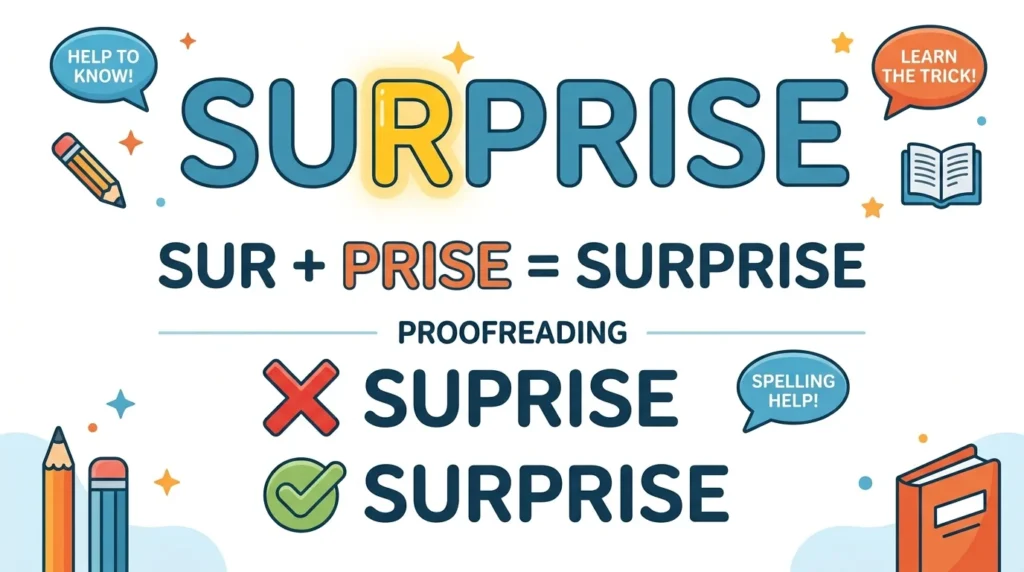
When learning how do you spell surprise, it is helpful to divide the word into smaller sections. You can remember it as “sur” and “prise.” Combining these parts gives you the complete spelling: surprise. This simple technique makes the word easier to recognize and reproduce when writing.
Another useful approach is to write the word several times while saying each letter aloud. Repetition helps your brain become familiar with the correct letter sequence. Once you recognize the pattern, spelling surprise becomes much more natural.
Breaking Down the Word Letter by Letter
Understanding the individual letters can make spelling easier, especially for people who are learning English as a second language. Surprise begins with S, followed by U and R. The next three letters are P, R, and I, while the final two letters are S and E.
Here is the complete breakdown:
| Letter position | Correct letter |
|---|---|
| 1 | S |
| 2 | U |
| 3 | R |
| 4 | P |
| 5 | R |
| 6 | I |
| 7 | S |
| 8 | E |
The table shows that surprise has eight letters. Paying attention to the two r letters is particularly important because this is where many people make mistakes.
What Does the Word Surprise Mean?
Surprise refers to something unexpected that causes a person to feel amazed, shocked, excited, or confused. It generally describes an experience or reaction that happens when something occurs without being anticipated. The emotion can be positive, negative, or neutral depending on the situation.
For example, imagine that your family organizes a birthday party without telling you. When you enter the room and see everyone waiting with decorations and a cake, you may feel surprised. Similarly, receiving an unexpected promotion, meeting an old friend, or hearing unexpected news can create a feeling of surprise.
The word is not limited to exciting experiences. A sudden change in plans, an unexpected examination question, or an unfamiliar result can also surprise someone. Therefore, its meaning depends on the surrounding sentence and the situation being discussed.
Surprise as a Noun
As a noun, surprise describes an unexpected event, experience, or feeling. It is commonly used when talking about gifts, celebrations, announcements, and unexpected developments.
For example, consider the sentence, “My friends planned a surprise for my birthday.” In this sentence, surprise refers to the unexpected event organized by the friends. Another example is, “The final result came as a complete surprise.” Here, the word describes an unexpected outcome.
The noun form is especially common in expressions such as birthday surprise, pleasant surprise, big surprise, and complete surprise. These expressions appear frequently in everyday conversations and written communication.
Surprise as a Verb
Surprise can also function as a verb. In this form, it means to cause someone to experience an unexpected feeling or reaction. The person or event creating the unexpected experience is performing the action of surprising someone.
For instance, “The unexpected visit surprised everyone.” This sentence explains that the visit caused people to experience surprise. Another example is, “I want to surprise my mother with a special gift.” Here, surprise describes the action of planning something unexpected.
Understanding both grammatical uses helps you write more accurately and use the word naturally in different situations.
Why Do People Commonly Misspell Surprise?
Although surprise is a familiar English word, its spelling can be confusing. One major reason is the way people pronounce it. During quick conversations, some sounds may become less noticeable, making it difficult to remember every letter when writing.
The most common spelling mistake is “suprise.” People often leave out the second r because they remember the sound of the word but not its exact letter arrangement. This mistake is particularly common among beginners who rely entirely on pronunciation instead of learning the written structure.
Another reason involves typing quickly. When someone writes a message, email, or social media caption without checking it, they may accidentally skip a letter. Such mistakes are generally easy to correct once the writer becomes familiar with the proper spelling.
Common Incorrect Spellings
Recognizing incorrect versions is an effective way to improve spelling accuracy. When you repeatedly see the correct form alongside common mistakes, it becomes easier to identify errors in your own writing.
Some frequently encountered mistakes include:
-
Suprise – Incorrect because it is missing the second r.
-
Surprize – Incorrect because the final s has been replaced with z.
-
Suprize – Incorrect because it contains both a missing r and an incorrect z.
-
Surprisse – Incorrect because it contains an unnecessary additional s.
The correct spelling in standard English is always surprise. Remembering this form will help you avoid mistakes in schoolwork, professional documents, and casual communication.
How to Pronounce Surprise Correctly
Pronunciation plays an important role in learning English vocabulary. Surprise is generally pronounced as suh-PRIZE, with the second syllable receiving the strongest emphasis. The first syllable is relatively soft, while the final part sounds similar to the word “prize.”
The pronunciation may vary slightly depending on regional accents, but the standard spelling remains unchanged. Some learners mistakenly believe that because the ending sounds like “prize,” the word should be written with a z. However, the correct spelling ends with the letter s.
A useful way to practice is to pronounce the word slowly before saying it at a natural conversational speed. Start with “sur” and then say “prise.” Combine both parts several times until the pronunciation feels comfortable.
Understanding the Difference Between Spelling and Pronunciation
English does not always follow predictable spelling rules. Some words have similar sounds but completely different written forms. This is why pronunciation alone cannot always tell you how to spell a word.
In the case of surprise, the ending may sound like a z, but it is written with an s. Similar spelling and pronunciation differences appear in many English words, making regular reading and writing practice important.
When you learn a new word, try to remember its spelling and pronunciation together. This creates a stronger connection between how the word looks and how it sounds.
Examples of Surprise in Everyday Sentences
Learning spelling becomes more effective when you understand how a word works in real sentences. Surprise appears in conversations about celebrations, relationships, education, travel, entertainment, and unexpected situations.
For example, someone might say, “I have a surprise for you.” This is a common expression used when preparing to reveal something unexpected. Similarly, “The surprise birthday party made her very happy” explains how an unexpected celebration created a positive reaction.
The word also works in professional and academic situations. A manager might say, “The announcement surprised the entire team.” A student could write, “The difficult question came as a surprise during the examination.” These examples demonstrate that the word is suitable for both informal and formal communication.
Practical Sentence Examples
Here are some additional examples that demonstrate different ways to use the word correctly:
-
My parents gave me a wonderful surprise on my birthday.
-
The unexpected result came as a complete surprise.
-
She wanted to surprise her best friend with a special gift.
-
Everyone was surprised when the teacher announced the holiday.
-
The news was a pleasant surprise for the entire family.
Reading these examples regularly can help you understand the word’s grammatical structure and remember its correct spelling.
Different Forms of the Word Surprise
English words often have different grammatical forms depending on how they are used in a sentence. Surprise is no exception. It can be modified to describe an action that happened in the past, an ongoing action, or a person experiencing an unexpected feeling.
Understanding these variations is helpful because the original spelling remains recognizable even when additional letters are added. For example, surprised describes a person who experienced something unexpected, while surprising describes something that creates an unexpected reaction.
The following table explains the common forms and their meanings.
| Word form | Meaning | Example |
|---|---|---|
| Surprise | Noun or base verb | I have a surprise. |
| Surprises | Plural noun or present verb | Life brings surprises. |
| Surprised | Past tense or adjective | She looked surprised. |
| Surprising | Present participle or adjective | It was surprising news. |
These forms are widely used in spoken and written English. Learning them together can improve vocabulary and help you create more natural sentences.
How to Remember the Correct Spelling of Surprise
Remembering difficult spellings becomes easier when you use simple learning techniques. Instead of memorizing the complete word without understanding its structure, divide it into smaller parts and practice each section.
For surprise, the most important trick is remembering the two r letters. You can mentally separate the word into “sur” and “prise.” Once you become familiar with these sections, you are less likely to leave out a letter while writing.
Another effective technique is to include the word in sentences. Writing sentences such as “I have a surprise for you” or “The announcement surprised everyone” helps reinforce the correct spelling through practical use.
Simple Spelling Practice Techniques
You do not need complicated exercises to improve your spelling. A few minutes of regular practice can make a noticeable difference over time.
Consider these useful habits:
-
Write surprise five times while saying each letter aloud.
-
Read sentences containing the word to recognize its spelling.
-
Remember that the correct spelling contains two r letters.
-
Use the word in your own sentences to strengthen memory.
These small exercises can be especially useful for students, beginners, and anyone who wants to improve everyday English communication.
When Should You Use the Word Surprise?
Surprise is appropriate in many different communication situations. In personal conversations, it can describe an unexpected gift, a celebration, or an exciting announcement. For example, you might tell a friend, “I have a surprise waiting for you.” This expression creates curiosity without revealing what is going to happen.
In professional writing, the word can describe an unexpected business development, a sudden change, or an unusual result. A sentence such as “The announcement surprised employees across the organization” communicates the situation clearly without using complicated vocabulary.
It is also useful in academic writing when explaining unexpected findings, unusual observations, or surprising results. However, writers should choose the word according to the tone of their content. Formal reports may sometimes benefit from alternatives such as unexpected, unanticipated, or unforeseen.
The Importance of Correct Spelling in Digital Communication
Digital communication has made written English an important part of everyday life. People regularly write emails, text messages, social media posts, online comments, educational assignments, and professional documents. Even a small spelling error can affect how clearly a message is understood.

Although many devices provide automatic spelling corrections, users should not depend on them completely. Autocorrect may fail to recognize the intended meaning or replace a correctly typed word with something different. Learning common vocabulary independently helps reduce these problems.
For anyone creating online content, correct spelling is particularly important. Search engines and readers both benefit from clear, well-written information. Repeated spelling mistakes can make an article appear less professional and may reduce readers’ confidence in its quality.
Therefore, learning how do you spell surprise correctly is not simply about remembering eight letters. It is also about developing stronger writing habits that support effective communication across different platforms.
Frequently Asked Questions About Surprise
1. How do you spell surprise in English?
The correct spelling is surprise. It contains eight letters: S, U, R, P, R, I, S, and E. Remembering the two r letters can help you avoid the most common spelling mistake.
2. Is surprise spelled with an S or Z?
Surprise is spelled with an s at the end, not a z. Although its ending may sound similar to the word prize, the standard English spelling uses s.
3. Is suprise a correct spelling?
No, suprise is incorrect. It is missing the second r. The correct spelling is surprise.
4. How many letters are there in surprise?
The word surprise contains eight letters. Its spelling begins with s and ends with e, with two r letters appearing in the middle.
5. What is the meaning of surprise?
Surprise means an unexpected event, experience, or feeling. It can describe something exciting, shocking, unusual, or completely unanticipated.
6. What is the past tense of surprise?
The past tense of surprise is surprised. For example, “The unexpected announcement surprised everyone.”
Conclusion
Learning the correct spelling of common English words is an important step toward becoming a confident writer. Surprise is a frequently used word that describes unexpected experiences, exciting moments, unusual events, and emotional reactions. Although its pronunciation can sometimes make its spelling confusing, remembering its eight-letter structure makes it much easier to write correctly.
If you are still wondering how do you spell surprise, remember the simple sequence S-U-R-P-R-I-S-E. Pay particular attention to the two r letters because leaving one out creates the common spelling mistake “suprise.” Practicing the word in sentences, reading regularly, and understanding its different grammatical forms can help strengthen your spelling skills.
Ultimately, correct spelling is about more than avoiding mistakes. It improves communication, makes writing easier to understand, and creates a positive impression in personal, academic, and professional situations. With a little practice, you can remember the correct spelling of surprise and use it confidently whenever the occasion calls for it.